Jump to HeaderJump to Main ContentJump to Footer
Michigan State University
  • Home
  • |
  • About
  • |
  • Personnel
    • Klemont Caron
    • Jacek Cholewicki, PhD
    • Lisa DeStefano, DO
    • Jessica Epstein
    • Richard Hallgren, PhD
    • Angela Lee MPH
    • JAimee Lippert
    • Clarence (NIC) Nicodemus, DO, PhD
    • Christopher Pohlod
    • John M. Popovich, Jr., PhD, DPT, ATC
    • Jacob Rowan, DO
    • Mathew A Zatkin DO
  • |
  • Opportunities
  • |
  • Department of OMM
  • |
  • Contact
Center for Neuromusculoskeletal Clinical Research
  • Home
  • About
  • Personnel
  • Opportunities
  • Department of OMM
  • Contact

< Home

< About

< Personnel

  • Klemont Caron
  • Jacek Cholewicki, PhD
  • Lisa DeStefano, DO
  • Jessica Epstein
  • Richard Hallgren, PhD
  • Angela Lee MPH
  • JAimee Lippert
  • Clarence (NIC) Nicodemus, DO, PhD
  • Christopher Pohlod
  • John M. Popovich, Jr., PhD, DPT, ATC
  • Jacob Rowan, DO
  • Mathew A Zatkin DO

< Opportunities

< Department of OMM

< Contact

Center for Neuromusculoskeletal Clinical Research > Facilities and Equipment >

Footwear Evaluation Laboratory

Michigan State University

Links

  • Osteopathic Manipulative Medicine
Michigan State University
Center for Neuromusculoskeletal Clinical Research

Center for Neuromusculoskeletal Clinical Research

This laboratory is used for experiments that evaluate comfort, design, and construction of shoes.

Below is a list of the equipment used in this lab.

1. Shoe Flex Tester
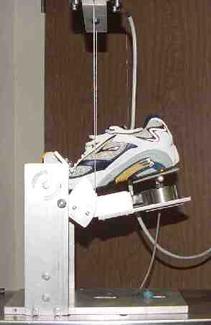
Shoe Flex Tester

  • Utilizes the MTS Servo-Hydraulic testing machine.
  • Evaluates the stiffness, flexibility and responsiveness of the shoe sole and forefoot in flexion.
  • Flexes shoes to 55-degree flexion angle.
  • Data collected includes: force, moment, stiffness, input energy and output energy.
  • This information is used to measure the flexural characteristics of the shoe in relation to the biomechanical response of the foot.

2. ASTM Type A Impact Machine
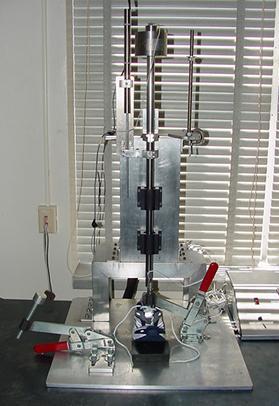
ASTM Type A Impact Machine

  • Simulates a 150-pound man jogging by dropping an 8.5 kg mass from a height of 50 mm.
  • Data collected includes: force, displacement, time-to-peak force, dwell time, stiffness of shoe, acceleration, input energy and output energy.
  • Measures the resiliency and shock-dispersing qualities of shoe sole systems.
  • This information is used to categorize shoes for shock absorption, stability and general comfort.

3. Artificial Thermal Foot
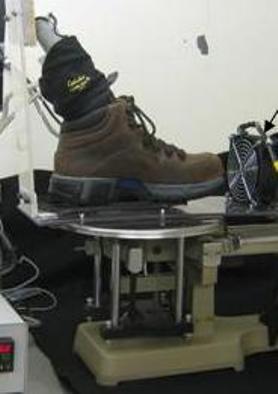
Artificial Thermal Foot

  • Simulates a foot at human body temperature releasing moisture into a shoe or boot.
  • Consists of tubing containing water and a heating element enclosed in a Gore-Tex sock, which allows the humidity to travel through but not any liquid water.
  • A balance is used to measure the changes in mass that occur when humidity escapes from the inside of the shoe.
  • Used to measure breathabilty or the amount of water vapor that is able to escape into the air.


Resources

  • About
  • Opportunities

College of Osteopathic Medicine

  • About the College
  • Future Students
  • Our Mission
  • News

Contact us

517-353-9110

Center for Neuromusculoskeletal Clinical Research

A413 East Fee Hall 965 Wilson Road East Lansing, MI 48824

Follow Us

  • Visit our Facebook page
  • Visit our Instagram page
  • Visit our YouTube page

If you're having accessibility issues, please let us know.

Michigan State University
  • Contact Information|
  • Site Map|
  • Privacy Statement|
  • Site Accessibility|
  • Call MSU: (517) 355-1855|
  • Visit: msu.edu|
  • Notice of Nondiscrimination|

SPARTANS WILL|© Michigan State University|