This laboratory is used for experiments that study the properties of biological materials. Below is a list of the equipment used in this lab.
1. Servo-Hydraulic Testing Machine
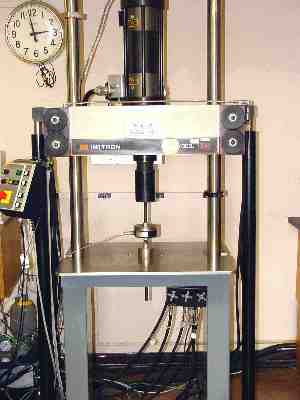
- Used to examine the physical strength of biological materials.
- Can produce computer-controlled displacements or forces of almost any desired shape and duration.
- Capable of producing 50ms sinewave load and position-controlled impacts of 13.0 kN.
- Data can be analyzed to produce force-time and force-displacement curves, as well as calculate stiffness, Young's modulus and yield strength.
2. Torque Testing Machine
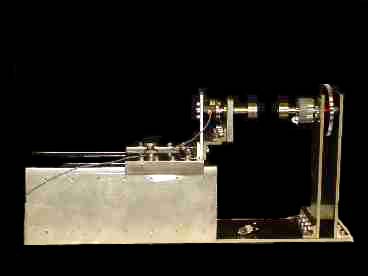
- Provides torque moment or rotational movement to an object using load cell of either 25 inch/lbs or 200 inch/lbs
- Uses optical rotary encoder to measure rotary motions.
- Used to evaluate surgical equipment and procedures, as well as bone repair methods and materials.
- Used to determine failure torque, energy and stiffness of these materials.
3. High-Speed Pneumatic Impacter
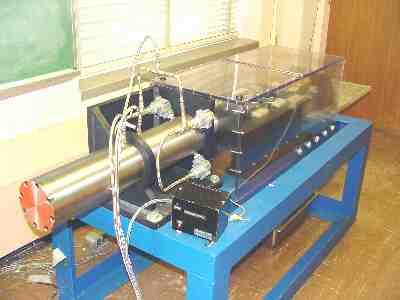
- Can produce an impact of up to 35 miles-per-hour to simulate a car crash or other high-speed impact injury.
- Uses high-pressure nitrogen to fire a piston, accelerating an impact mass toward the target object.
- Initial velocity of the impact mass is measured with an optically triggered speed trap. The impact forces are measured with an inertially compensated load cell.
- Used to test the response of tissues and bones to high-speed impacts.
- Results are used to design cars, helmets and other safety equipment.
4. Hyperextension Fixture
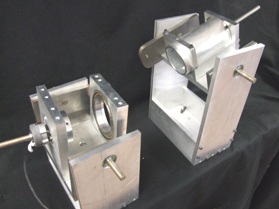
- Custom-designed to test behavior of specimens under loads while allowing rotation.
- Used in conjunction with the XY table to simulate tensile or compressive stresses.
- Used in research to analyze the mechanical behavior of knee joints when forces similar to those experienced in nature are applied.
5. Stainless Steel XY Table
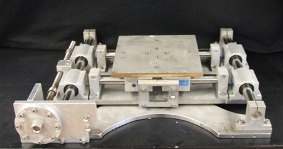
- Allows researcher to exert tensile or compressive forces in Z-direction while allowing free movement in the X and Y directions.
- Can be mounted on the Instron testing machine, where data can be captured and the XY displacement data from the table can be synchronized.
- Table's position can be measured to 1/1000 of a millimeter and can be read at 10,000 samples per second.
- Y Axis can be fixed in order to measure any loads in Y direction.
6. Aluminum XY Table
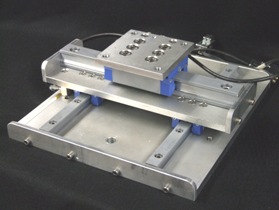
- Allows researcher to exert tensile or compressive forces in Z-direction while allowing free movement in the X and Y directions.
- Can be mounted on the Instron testing machine, where data can be captured and the XY displacement data from the table can be synchronized.
- Table's position can be measured to 1/1000 of a millimeter and can be read at 10,000 samples per second.
- Smaller, designed for lighter loads than the stainless steel XY Table.
7. Rotary Encoders
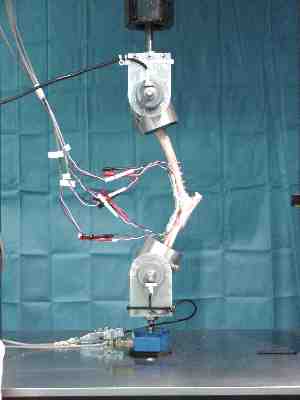
- Available with a resolution of 0.02 degrees, sampled at up to 10,000 samples per second.
- Data from encoders, XY Table and Instron can be synchronized.
- Used to measure angular motions.
- Experiment shown uses two encoders to calculate the bending moment at the joint.